In my first edition of this post, I shared the reluctance I once had about having to rewrite a draft of a story. At the time, my second published novel had just come out, and my process of writing it—and yes, rewriting it—taught me the value of adjusting certain aspects of your work. In fact, Forgetting My Way Back to You had taken me at least three attempts to get the plot up to my standards.
Five years later, that same novel has again taught me the value in taking the opportunity to tweak your past works. Under ordinary conditions, I wouldn’t revisit my past published books because I realize I’ll always find something I want to change. I’m my own worst critic, and I don’t even read my books after they’re released, since I know I’ll be picking apart sentences and such more than I would enjoy the experience.
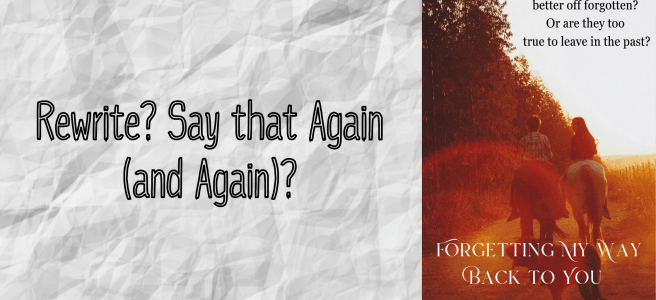
A recent development in my career forced me into that position, however. I was saddened to learn that Vinspire Publishing, the company I worked with on Forgetting My Way Back to You, is closing their doors after twenty years of releasing great stories. To my gratitude, they gave me the rights to pursue publication of it again however I wanted to, so after some debate, I opted to move forward with independently publishing the book. In the process, I decided I wanted to refresh it in a couple of ways, first being a new cover.

With this new look, I toyed around with the idea of making a few minor adjustments to the prose. In previous posts, I’ve discussed what it’s like to collaborate with an editor. While it can be a tedious and taxing process, I still deem it a necessary step for any writer. I’ve been helped so much over the years to learn the best ways to construct a storyline with a view to connecting with readers.
Hence, I would never want to squander the value in the editing I was fortunate enough to receive. Because of my inexperience back then, my editor had to work with me quite a bit to guide me in what was suitable for mainstream fiction. One of the biggest rules I had to adapt to was avoiding the habit of so-called head-hopping, which is alternating between different characters’ perspectives in a single scene.
I reviewed the manuscript while I prepared to rerelease the e-book with a few ideas of certain areas that I remembered didn’t end up the way I intended. Why? Admittedly, my editor was very particular in her criteria, and though I benefited immensely from it, a couple of somewhat minor matters never set well with me. I appreciate her input and reasoning behind it, but in speaking with readers, I felt that the adjustments took away from the impact of the scenes, both of which meant a great deal to me. Thus, I used this opportunity to restore the mood I originally wanted to convey, while still endeavoring to write by the rules. Not being on a fixed deadline helped me do so, too, since I had adequate time to consider my amendments.
Furthermore, I’ve learned a lot since I completed the book six years ago, primarily about word choice. Though I’ve always been conscious about not overusing a particular word, my review showed me how often I used the common words, such as come and know. Worse yet, I had the habit of saying, come to know! My current publisher, The Wild Rose Press, has trained me to substitute a lot of those common phrases with stronger terms, like return and recognize. Thus, I utilized that instruction to polish the prose, even if it reduced my word count a smidge.
If I’m being honest, at the start of this self-editing, I had a giddiness inside me, like an unsupervised child. It can be fun having no one to answer to after my years of complying with editors and companies. As I proceeded, though, I realized several occasions where my tough editor actually showed quite a bit of leniency. In those cases, I had to cringe and ultimately revised them in the way she no doubt wanted me to—but bit her tongue due to my lack of experience.
This revision taught me several lessons about myself and writing in general. For one thing, I was reminded of how much you grow through each project you undertake. While you may be embarrassed looking back, you need to embrace your early beginnings and how they helped you develop. In fact, I probably could’ve changed more of the story to showcase who I am now, but for the most part, I wanted to preserve the writer I was then.
Along with that, it again proved to me the value of guidance. People have remarked to me that they can’t imagine having an editor pick apart your story—because after all, it’s your story. Sure, a few adjustments have haunted me for an extended period, but by and large, I’ve realized later that my original draft was inferior. We’re biased with regard our own style and so forth, and an outside perspective can assist in smoothing out the kinks to enhance the plot.
Sixteen years have passed since I began the first draft of what became Forgetting My Way Back to You. Back then, I would’ve quit immediately if I knew I’d continue tweaking it up till now! Considering the plot centers around second—and third—chances, however, I reckon my persistent efforts are pretty appropriate!
Forgetting My Way Back to You (Karina’s Version) is available now at Amazon and Barnes & Noble!
Also See
Forgetting My Way Back to You Release: Twelve Years in the Making
Editors: A One-Person Jury or a Friendly Doorman to the World of Readers?
 KarinaBartow.com