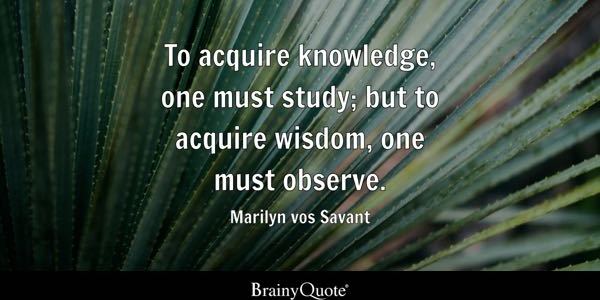
Columnist and author Marilyn Vos Savant once stated, “To acquire knowledge, one must study; but to acquire wisdom, one must observe.” Indeed, observation is a key component to finding success in this world. Some scientists make a whole career out of observing other animal, plant, and space life in efforts to understand more about their subjects for future purposes. Even in regular workplaces, a new employee learns his/her job by watching a more experienced coworker go about their duties.
Since my parents were older when I was born, I’ve had plenty of opportunity to observe. I was the youngest in my family and among our close circle of friends, so I often saw others go through the various stages of growing up before I made it there. Plus, my Cerebral Palsy and the limited mobility that comes with it forced me to be a bystander—actually, a bysitter!—to a lot of the shenanigans around me. Though I didn’t always enjoy that role, I came to appreciate the vantage point it gave me in life.
In all honesty, the experience I gained from that position has done much to shape my choices and actions. Be assured, I’ve definitely made my share of bad decisions and had my own blunders because of them. All the same, I feel that I’ve avoided some pitfalls that I’ve seen others have to fall into on their own to learn the lesson. On the other hand, I’ve also benefited from the positive examples of others and adopted qualities that I discern has helped them succeed.
The disadvantages to being observant can be that it gives you a wakeup call to the difficulties of reality. When you’re young, it’s easy just to scratch off the experiences that appear unpleasant, opting not to take this class or this job because a friend didn’t enjoy it. As you age, though, you don’t have the flexibility to avoid such necessities, and sometimes, you can even be afraid of going after a dream because it didn’t turn out well for another person.
Is it really wise to deprive ourselves of such pursuits on account of other people’s misfortunes? Should we allow our observations to handcuff us from taking chances?
As I was debating this myself, I took a lesson from a handful of unflattering remarks I’ve received. On a couple of occasions, people who are dealing with aches and pains—and lack of tact—have told me they would never want to be in my condition. I can’t say I appreciate such comments, but I understand where they’re coming from.
Just the same, I fight the urge to tell them it’s not as bad as it may seem. I’ve done my best to make the most out of my limitations and live a productive and meaningful life. From their short-sighted viewpoint, however, all they can see are my obstacles and lack of independence, which they want to continue to be able to maintain.
Likewise, we can’t accurately assess someone else’s circumstances or how we would react to them if we were in their shoes. Everybody is different, and no one copes with matters the same way. Even if we’re observing someone who has a similar background or personality as we do, we can’t be guaranteed to fail at something they have because of all of the variables at play. They may consider a certain aspect unpleasant whereas we find it enjoyable. In such cases, we can use our observations to our benefit by avoiding a mindset or a habit that perhaps contributed to the reason for their unfavorable outcome.
While there’s no guarantee of success or that we won’t have the same results as others, we also shouldn’t rob ourselves of opportunities based on outsiders’ disappointments. When we buy a product and read the reviews, we often find that even the highest rated items still have a few unsatisfied customers, who may always complain or might not use it as it was intended. Similarly, the observations we take in can give us a reasonable measuring stick, but they can also misguide us if we let them. Thus, we ought to combine wisdom and bravery to carve out our own path.

 KarinaBartow.com
One thought on “Is Observation the Best Education?”